


Success Music Studio

color code the musical form - Picture of a Colorful Clef and Piano

How to Color Code the Musical Form to Unlock LD & Special Needs Music Students’ Learning Potential

Facebook
Twitter

Estimated reading time 2 minutes

Table of Contents

Color Code the Musical Form for LD & Special Needs Students

Have you ever had your student get totally lost while trying to read the music score? I have. Color coding in music lessons is not limited to just notes and rhythms. You can also color code the musical form to help students with confusing signs of repetition. Read more to learn how to color code the musical form.

LD and  special needs students are not alone in getting confused. Typical learners often struggle with the signs of repetition too. 

This article uses musical terms. For definitions, see the Glossary at the end of the post.

How to Harmonize in Minor Keys - equalizer - Can Singers Sing in Tune Even if They Do Not Hear Their Voice

Why Color Code the Musical Form? - Repetition Signs

Long after the invention of printed text, musical scores continued to be hand copied. To save time and money, composers invented repetition symbols.

The symbols allow longer musical pieces to be notated in smaller spaces. They also helped shape the form of the music. However, this meant that the eye had to jump around the score to follow the music. 

Even if musicians do not confuse the repetition symbols, they may still find it difficult to follow the score. Color coding the musical form helps solve this issue.

It creates a guide for the eyes to follow. The color also helps make the repetition signs pop off of the page.

How Color Coding the Form Works

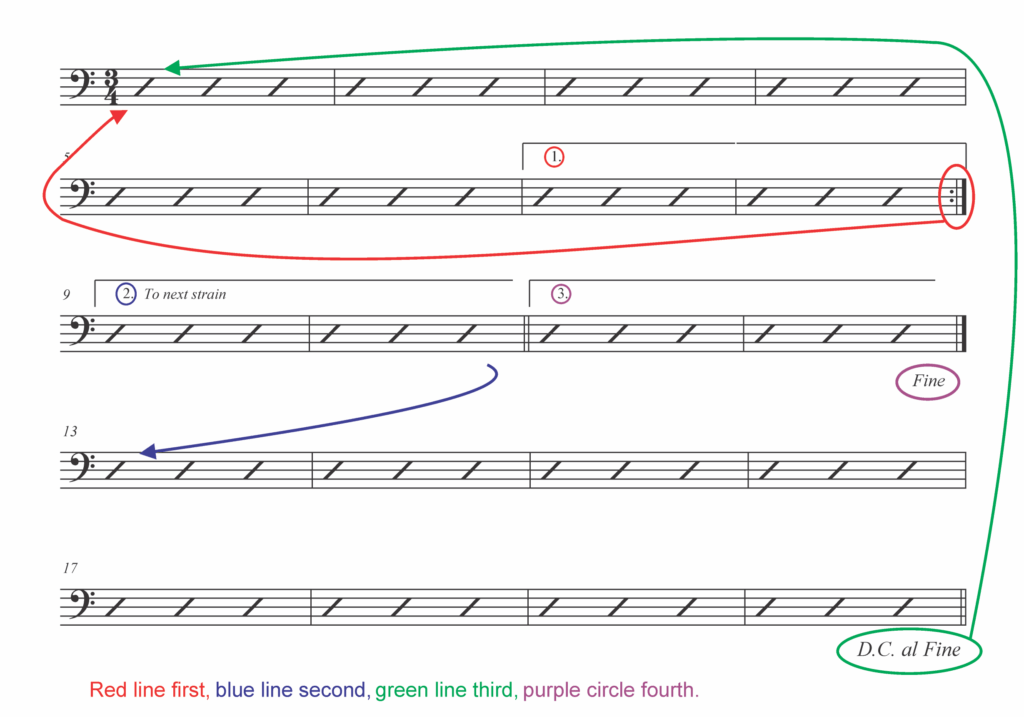
The following diagram shows how color coded circles and lines can help clarify the order in which the parts of the score are played.

At the bottom of the diagram is a guide showing which color coded line or circle comes first, second, and so on. The color keeps the students from getting confused about where to go next in the score.

Have the students trace their fingers over the score, following the color coded form.

Mobile users: for best results reading the music, tilt your screen 90o to the right.

How to Color Code the Musical Form to Unlock LD & Special Needs Music Students' Learning Potential - Example of Color Coded Form - How to Learn Music Theory with a Learning Disability

Conclusion

Adults often balk at color coding notes and rhythms. However, color coding the musical form is effective for any age range.

LDADDASD, and other special needs students particularly benefit from colorized scores. Using multisensory teaching strategies can help students avoid mistakes and encourage success.

© 2020 Geoffrey Keith

Newsletter Signup

Join me for in-person or online music lessons today!

Back to the Color Coding Blogs Page

Back to the Successful Music Student Blogs Page

Glossary

How to Unlock the Secret of Writing Dance Songs

Do you want to write exciting dance songs? Do you worry that it’ll be tough to create a good dance song groove? There are tricks that you can use to help get your creative juices going and consistently find good grooves. Click to learn how to unlock the secret of writing dance songs. Estimated reading time 4 minutes.

Read More


memory and songwriting - young woman remembering - brainstorming your song titles - Learning Differences and Spatial Ability - after they can sight-read what’s left for musicians to learn - How Long Do You Take to Memorize a Piece of Piano Music - The Gifted Dyslexic and Insight Learning

Memory and Songwriting

Do you want your song to be catchy? If people can't remember your song, you’ve got a problem. Therefore, you need know how humans remember things. Read more to understand the connection between memory and songwriting. Estimated reading time 4 minutes.

Read More
Basic Arpeggios Explained in Less Than Three Minutes - Harp

Basic Arpeggios Explained in Less Than 3 Minutes

Are you clueless about arpeggios? An arpeggio, or broken chord, is a basic musical figuration that’s used in multiple musical genres and playing styles. It adds grace and elegance to your music, allowing you to achieve a lighter and more sophisticated sound. Keep reading “Basic Arpeggios Explained in Less Than 3 Minutes” to learn what they are and how they work. Estimated reading time 2 minutes.

Read More

How to Tune Your Incredibly Cool Microtonal Keyboard - Woman with Keyboard

How to Tune Your Incredibly Cool Microtonal Keyboard

Do you want to know how to tune your microtonal keyboard so that your chords sound incredibly cool? The term microtonal covers a lot of different types of tuning systems. Some which will sound like a cappella music, and others which will sound exotic and otherworldly. Keep reading “How to Tune Your Incredibly Cool Microtonal Keyboard” to learn how to have beautiful sounding harmonies. Estimated reading time 5 minutes.

Read More